






Development of the Banking Sector in Nepal
The development of the banking sector in Nepal can be understood as a gradual transition from traditional informal lending to a modern, regulated, competitive and increasingly digital financial system. Modern banking in Nepal began with the establishment of Nepal Bank Limited in 1937, followed by the establishment of Nepal Rastra Bank (NRB) in 1956, which became the central authority for monetary and banking development.
- Introduction
The banking sector is an important part of Nepal’s financial system. It mobilizes savings from individuals and institutions and channels those funds toward productive activities such as agriculture, industry, trade, infrastructure, housing and business.
The development of banking in Nepal has passed through several important stages:
- Pre-modern/informal banking period
- Beginning of modern banking — 1937
- Establishment of NRB — 1956
- Expansion of government-owned and specialized banks — 1960s–1970s
- Financial liberalization — 1980s
- Rapid expansion of private and joint-venture institutions — 1990s
- Financial-sector reform and consolidation — 2000s
- Merger and acquisition era — 2010s onward
- Digital banking and fintech development — recent period
- Banking Before 1937
Before the establishment of modern banks, Nepal did not have a developed formal banking system.
Financial transactions were conducted through:
- Traditional moneylenders
- Merchants and traders
- Informal credit arrangements
- Government institutions
- Indigenous financial practices
One important historical institution was Tejarath Adda, established in 1880. It provided loans, particularly to government employees and landlords, rather than functioning as a modern deposit-taking commercial bank.
Therefore, the pre-1937 period can be described as a period of limited and informal financial intermediation.
Major characteristics
- Very limited banking facilities
- Lack of organized commercial banking
- Dependence on moneylenders
- Limited monetization of the economy
- Limited access to formal credit
- Absence of a central bank
- Establishment of Nepal Bank Limited — 1937
The most important milestone in Nepal’s modern banking history was the establishment of Nepal Bank Limited (NBL) in 1937.
It was the first formal commercial bank in Nepal and marked the beginning of modern banking in the country.
At that time, Nepal’s economy was largely agricultural and the banking network was extremely small.
Nepal Bank Limited introduced formal banking services such as:
- Deposit collection
- Lending
- Commercial transactions
- Banking accounts
- Payment services
Before the establishment of a central bank, Nepal Bank also performed some functions that later became central-bank responsibilities.
- Establishment of Nepal Rastra Bank — 1956
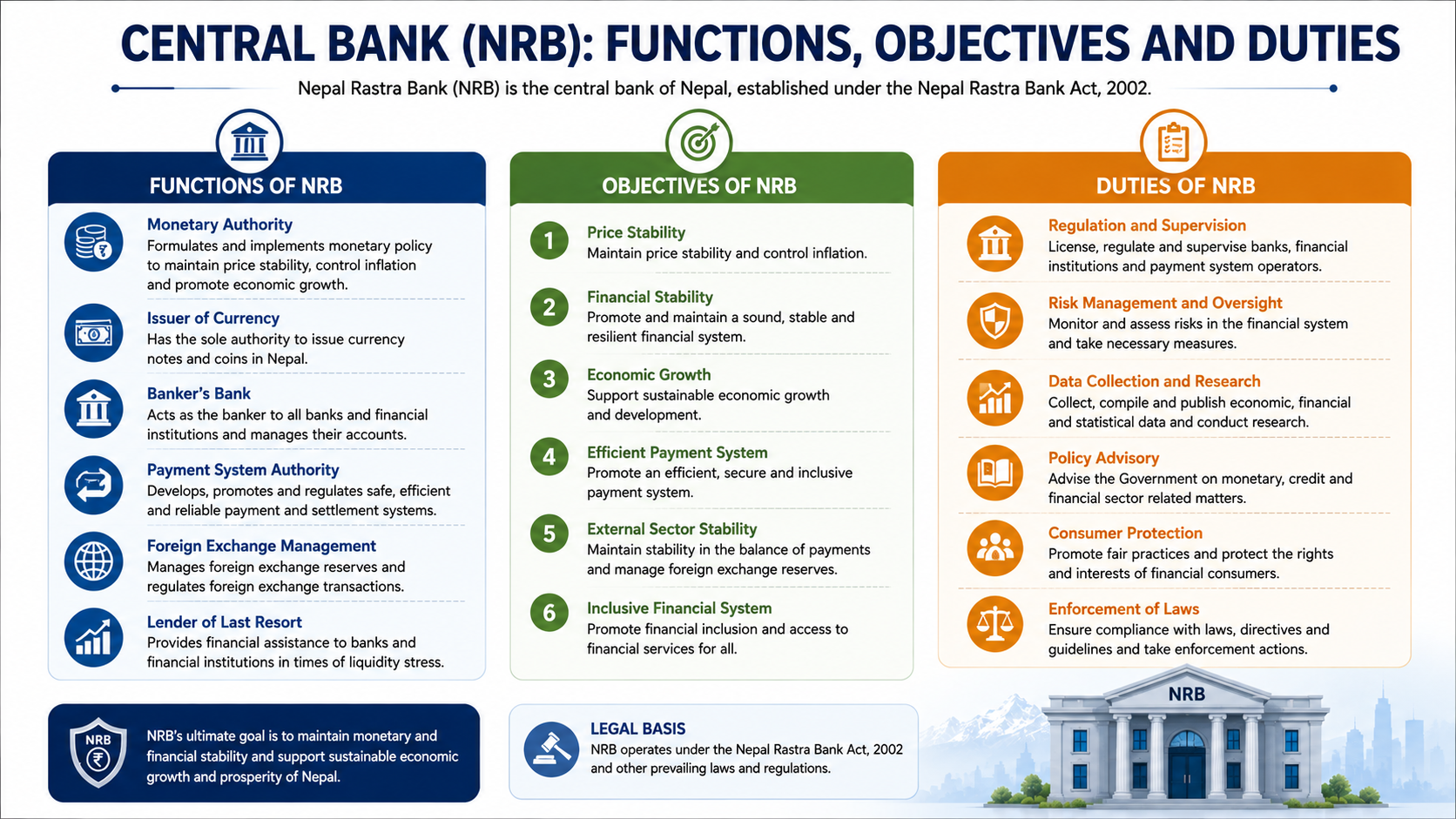
A major turning point came with the establishment of Nepal Rastra Bank (NRB) in 1956 under the Nepal Rastra Bank Act, 1955.
NRB was established as the central bank of Nepal. One of its important purposes was to guide the development of the country’s emerging financial sector.
At the time, Nepal had:
- Very limited banking services
- A weak formal financial market
- Limited monetization
- A dual-currency environment involving Nepalese and Indian currency
- Limited financial infrastructure
NRB therefore played a major role in developing the institutional foundation of modern banking.
Major contributions of NRB
NRB gradually assumed responsibility for:
- Currency issuance
- Monetary management
- Bank regulation
- Bank supervision
- Foreign-exchange management
- Development of banking infrastructure
- Banking-system development
- Expansion of Government-Owned Banks — 1960s
After the establishment of NRB, the government began establishing specialized and commercial financial institutions to support national development.
Rastriya Banijya Bank — 1966
Rastriya Banijya Bank (RBB) was established in 1966 as a government-owned commercial bank.
Its establishment significantly expanded banking services and helped extend banking facilities beyond the limited network of Nepal Bank.
RBB played an important role in:
- Deposit mobilization
- Lending
- Industrial development
- Agricultural financing
- Expansion of banking services across the country
- Development of Specialized Financial Institutions
Nepal also established specialized institutions to finance particular sectors of the economy.
Nepal Industrial Development Corporation
An Industrial Development Centre was established in 1959 and was later transformed into the Nepal Industrial Development Corporation (NIDC).
NIDC served as a specialized development-finance institution and supported industrial development. It was later merged with Rastriya Banijya Bank in 2018.
Agricultural Development Bank
The Agricultural Development Bank Nepal (ADBL) was established in 1968 under the Agricultural Development Bank Act, 1967.
Its major objective was to provide financial services and credit for:
- Agriculture
- Rural development
- Farmers
- Cooperatives
- Productive rural activities
The establishment of ADBL was particularly important because agriculture dominated Nepal’s economy.
- Banking Development During the 1970s
During the 1970s, banking services continued to expand.
The government emphasized:
- Rural banking
- Agricultural credit
- Industrial financing
- Development financing
- Branch expansion
- Mobilization of domestic savings
However, the banking sector was still largely state-dominated.
The major institutions were primarily government-controlled, and competition was limited.
Problems during this period
- Limited competition
- Low banking penetration
- Weak financial infrastructure
- Limited access in rural areas
- Administrative control over interest rates
- Inefficient operations in some state-owned institutions
- Financial Liberalization in the 1980s
The 1980s marked a major transformation in Nepal’s banking sector.
Nepal began implementing financial-sector liberalization policies.
According to NRB’s historical review, financial liberalization involved measures such as:
- Interest-rate deregulation
- Allowing private-sector participation
- Licensing private/joint-venture banks
- Reforming state-owned banks
- Increasing competition
This changed the banking sector from a predominantly government-controlled system toward a mixed public-private banking system.
- Establishment of the First Joint-Venture Bank
A landmark event occurred in 1984, when Nepal Arab Bank Limited was established as Nepal’s first private-sector and foreign joint-venture bank. It is now known as Nabil Bank.
The arrival of joint-venture banks introduced:
- Greater competition
- Modern banking techniques
- Improved customer service
- New banking products
- International banking practices
- Improved management practices
- Technological improvements
Other joint-venture banks subsequently entered the market.
- Development During the 1990s
The 1990s were one of the most important periods in the development of Nepal’s banking industry.
Following economic liberalization, the number of private banks and financial institutions increased rapidly.
NRB notes that financial-sector growth accelerated particularly during the 1990s and 2000s following economic and financial liberalization.
Major developments
- Growth of private commercial banks
- Growth of joint-venture banks
- Expansion of finance companies
- Development of development banks
- Expansion of branch networks
- Increased competition
- Introduction of new banking products
- Increasing use of technology
- Development of Finance Companies
The Finance Company Act, 1985 created a legal basis for the development of finance companies.
The first finance company, Nepal Housing Development Finance Company, was established in 1992.
Its establishment was followed by the proliferation of other finance companies.
Finance companies expanded access to financial services, particularly in areas such as:
- Consumer finance
- Housing finance
- Hire purchase
- Business finance
- Other specialized lending
- Development of Development Banks
Development banks emerged to fill financing gaps that were not adequately served by traditional commercial banks.
Their major areas included:
- Agriculture
- Industry
- Small businesses
- Regional development
- Infrastructure
- SMEs
They became an important component of Nepal’s financial system.
- Microfinance Development
Microfinance became increasingly important, particularly from the 1990s onward.
Microfinance institutions were established to provide financial services to people who had limited access to conventional banking.
They focused particularly on:
- Low-income households
- Rural communities
- Small entrepreneurs
- Farmers
- Micro-enterprises
- Women and underserved groups
Microfinance contributed to expanding financial inclusion, although the sector has also faced challenges involving credit quality, over-indebtedness and governance.
- Financial Sector Reform — 2000s
The banking sector entered another major reform phase in the early 2000s.
Nepal implemented a comprehensive Financial Sector Reform Program beginning in 2001.
The reform process aimed to strengthen the financial sector, including major state-owned institutions such as:
- Nepal Bank Limited
- Rastriya Banijya Bank
- Agricultural Development Bank
- Nepal Industrial Development Corporation
Objectives of financial-sector reform
- Improve bank efficiency
- Strengthen corporate governance
- Improve financial reporting
- Reduce non-performing loans
- Improve risk management
- Strengthen capital adequacy
- Improve supervision
- Increase competition
- Strengthen financial stability
- Development of Legal Framework
An important milestone was the enactment of the Bank and Financial Institutions Act (BAFIA), 2006.
BAFIA provided an umbrella legal framework for banks and financial institutions and replaced several separate laws governing different institutions.
Later, BAFIA 2017 replaced the 2006 Act.
This helped establish a more unified regulatory framework for Nepal’s banking and financial sector.
- Consolidation and Merger of Banks
During the 2010s and afterward, Nepal’s banking sector entered a period of mergers and acquisitions.
The number of financial institutions had increased significantly, creating concerns regarding:
- Excessive competition
- Governance
- Capital adequacy
- Operational efficiency
- Financial stability
- Duplication of banking networks
NRB therefore encouraged consolidation through merger and acquisition policies.
Effects of consolidation
- Stronger capital base
- Larger institutions
- Better risk-bearing capacity
- Reduced duplication
- Improved operational efficiency
- More robust financial institutions
For example, several development banks and finance companies were acquired or merged into larger commercial banks.
- Transformation from State-Dominated to Competitive Banking
The overall transformation can be summarized as:
State-dominated banking
↓
Financial liberalization
↓
Joint-venture banks
↓
Private commercial banks
↓
Development banks and finance companies
↓
Microfinance institutions
↓
Merger and consolidation
↓
Modern digital banking system
This represents the major structural transformation of Nepal’s banking sector.
- Development of Banking Technology
Technology has dramatically changed Nepal’s banking industry.
Traditional banking relied heavily on:
- Cash
- Physical branches
- Paper records
- Manual transactions
Modern banking increasingly uses:
- Core Banking Systems
- ATMs
- Debit cards
- Credit cards
- Internet banking
- Mobile banking
- QR payments
- Electronic fund transfers
- Digital wallets
- Online account services
The growth of digital payments has made banking faster and more accessible.
- Development of Digital Banking
Digital banking is now one of the fastest-changing areas of Nepal’s financial sector.
Customers can increasingly perform banking activities without visiting a branch.
Common digital services
- Mobile banking
- Internet banking
- QR payments
- Fund transfers
- Bill payments
- Utility payments
- Digital wallets
- Online applications
- Card payments
The development of payment infrastructure and its regulation has become an important part of NRB’s responsibilities. NRB identifies the development of a secure, healthy and efficient payment system as one of its objectives.
- Expansion of Financial Inclusion
Banking development has also involved expanding access to financial services.
Financial inclusion has been promoted through:
- Branch expansion
- Rural banking
- Microfinance
- Mobile banking
- Digital payments
- Agent-based services
- Financial literacy
The objective is to ensure that people in rural and underserved communities can access:
- Savings
- Credit
- Payments
- Remittances
- Insurance and other financial services
- Role of Remittances in Banking Development
Remittance has become an important part of Nepal’s economy and banking system.
Banks and financial institutions provide services for:
- Receiving remittances
- Sending remittances through authorized channels
- Foreign-exchange transactions
- Remittance-linked accounts
- Digital transfers
Remittance inflows also contribute to deposit mobilization and liquidity within the formal financial system.
- Growth of Banking Competition
Financial liberalization substantially increased competition.
Banks began competing through:
- Deposit interest rates
- Loan products
- Digital services
- Branch networks
- Customer service
- Credit cards
- Mobile banking
- Remittance services
- SME financing
Competition encouraged banks to modernize their services.
However, excessive competition can also create risks if institutions take excessive risks to increase market share.
- Modern Banking Regulation
As banking became more complex, NRB strengthened prudential regulation and supervision.
Banks are required to comply with regulatory standards involving:
- Capital adequacy
- Liquidity
- Loan classification
- Provisioning
- Risk management
- Corporate governance
- Large exposures
- Reporting
- Anti-money laundering
- Consumer protection
This regulatory framework is designed to maintain confidence and stability in the financial system.
- Current Structure of Nepal’s Banking and Financial System
Nepal’s financial system consists of different categories of regulated banks and financial institutions.
Broadly, NRB has historically classified licensed institutions into:
Class A
Commercial Banks
Class B
Development Banks
Class C
Finance Companies
Class D
Microfinance Financial Institutions
In addition, the wider financial system includes other institutions and service providers such as:
- Infrastructure-financing institutions
- Cooperatives
- Payment service providers
- Payment system operators
- Insurance companies
- Capital-market institutions
- Remittance companies
The precise number and structure of institutions change over time because of licensing, mergers and acquisitions.
- Major Stages of Banking Development in Nepal
| Period | Major Development |
| Before 1937 | Informal and traditional financial system |
| 1880 | Tejarath Adda established |
| 1937 | Nepal Bank Limited established — first modern commercial bank |
| 1956 | Nepal Rastra Bank established as central bank |
| 1960s | Expansion of government-owned and specialized financial institutions |
| 1966 | Rastriya Banijya Bank established |
| 1968 | Agricultural Development Bank established |
| 1980s | Financial liberalization begins |
| 1984 | First foreign joint-venture/private-sector commercial bank established |
| 1990s | Rapid expansion of private banks and financial institutions |
| 1990s onward | Growth of development banks and microfinance |
| 2001 onward | Comprehensive financial-sector reform |
| 2006 | BAFIA introduced as umbrella legislation |
| 2010s | Rapid mergers and acquisitions |
| 2017 | BAFIA 2017 enacted |
| Recent years | Digital banking, fintech, QR payments and electronic payments expand |
The historical sequence and major institutional milestones are documented by NRB’s financial-sector publications.
- Major Achievements of Nepal’s Banking Sector
The banking sector has achieved significant progress.
- Expansion of banking institutions
Nepal moved from having a single formal commercial bank to a diverse financial system.
- Increased geographical coverage
Banking services have expanded considerably across the country.
- Increased financial access
More households and businesses can access formal financial services.
- Increased deposit mobilization
Banks have become major institutions for mobilizing domestic savings.
- Increased credit availability
Banking institutions provide financing for:
- Agriculture
- Industry
- Trade
- Housing
- SMEs
- Infrastructure
- Consumption
- Improved technology
Banking has moved from manual transactions to sophisticated digital systems.
- Greater competition
Private and joint-venture banks introduced competitive practices.
- Improved regulation
NRB has developed a stronger prudential regulatory and supervisory framework.
- Financial-sector consolidation
Mergers and acquisitions have created larger and better-capitalized institutions.
- Development of payment systems
Electronic and digital payments have expanded substantially.
- Problems and Challenges of Nepal’s Banking Sector
Despite significant progress, the banking sector faces several challenges.
27.1 Non-performing loans
Poor-quality loans can affect profitability and financial stability.
27.2 Excessive competition
Aggressive competition for deposits and lending can increase risk.
27.3 Corporate governance
Weak governance can result in poor lending decisions and operational problems.
27.4 Concentration of credit
Excessive lending to particular sectors can increase systemic risk.
27.5 Liquidity problems
Banks may sometimes experience mismatches between deposits and lending.
27.6 Rural access
Although access has improved, ensuring sustainable and high-quality financial services in remote areas remains challenging.
27.7 Cybersecurity
Digital banking creates increasing risks related to:
- Cyberattacks
- Phishing
- Identity theft
- Digital fraud
- Data breaches
27.8 Financial literacy
Many customers still need greater awareness about:
- Interest rates
- Digital security
- Loans
- Investments
- Financial fraud
27.9 Digital divide
Not everyone has equal access to smartphones, internet services and digital financial products.
- Overall Transformation of Nepal’s Banking Sector
The development of banking in Nepal can be summarized in five broad phases:
Phase I: Pre-1937
Traditional and informal finance
↓
Phase II: 1937–1956
Beginning of modern commercial banking
↓
Phase III: 1956–1984
State-led banking and financial development
↓
Phase IV: 1984–2000
Financial liberalization and rapid private-sector expansion
↓
Phase V: 2000–Present
Reform, consolidation, competition and digital transformation
NRB itself describes Nepal’s financial-sector development in broad phases centered around the pre-NRB period, the period beginning with the NRB Act of 1955, the financial-liberalization period beginning around 1984, and the current framework following the NRB Act of 2002.
- Importance of Banking Sector Development to Nepal’s Economy
The development of the banking sector has contributed to Nepal’s economy in several ways.
Mobilization of savings
Banks collect scattered savings and convert them into investible funds.
Capital formation
Banks help finance investment in businesses and infrastructure.
Employment
Banking and credit-supported businesses generate employment.
Agricultural development
Banks and specialized institutions provide financing to farmers and agricultural businesses.
Industrial development
Credit supports industries and businesses.
Trade development
Banks facilitate domestic and international trade through payment and financing services.
Remittance facilitation
Banks provide formal channels for remittance transactions.
Financial inclusion
Banking brings more people into the formal financial system.
Economic stability
A sound banking system supports monetary and financial stability.
- Conclusion
The development of the banking sector in Nepal has been a long and gradual process. The modern banking era began with the establishment of Nepal Bank Limited in 1937. The establishment of Nepal Rastra Bank in 1956 provided the institutional foundation for organized monetary and banking development. Government-owned institutions such as Rastriya Banijya Bank and Agricultural Development Bank expanded banking and development finance during the following decades.
The financial liberalization of the 1980s marked another major turning point, opening the sector to private and foreign joint-venture participation. The 1990s and 2000s brought rapid growth in banks, development banks, finance companies and microfinance institutions. Financial-sector reforms, BAFIA, stronger regulation and mergers subsequently helped reshape the sector.
Today, Nepal’s banking sector is moving toward a technology-driven, competitive, consolidated and digitally connected financial system. At the same time, issues such as credit quality, corporate governance, financial stability, cybersecurity, financial inclusion and responsible lending remain important challenges.