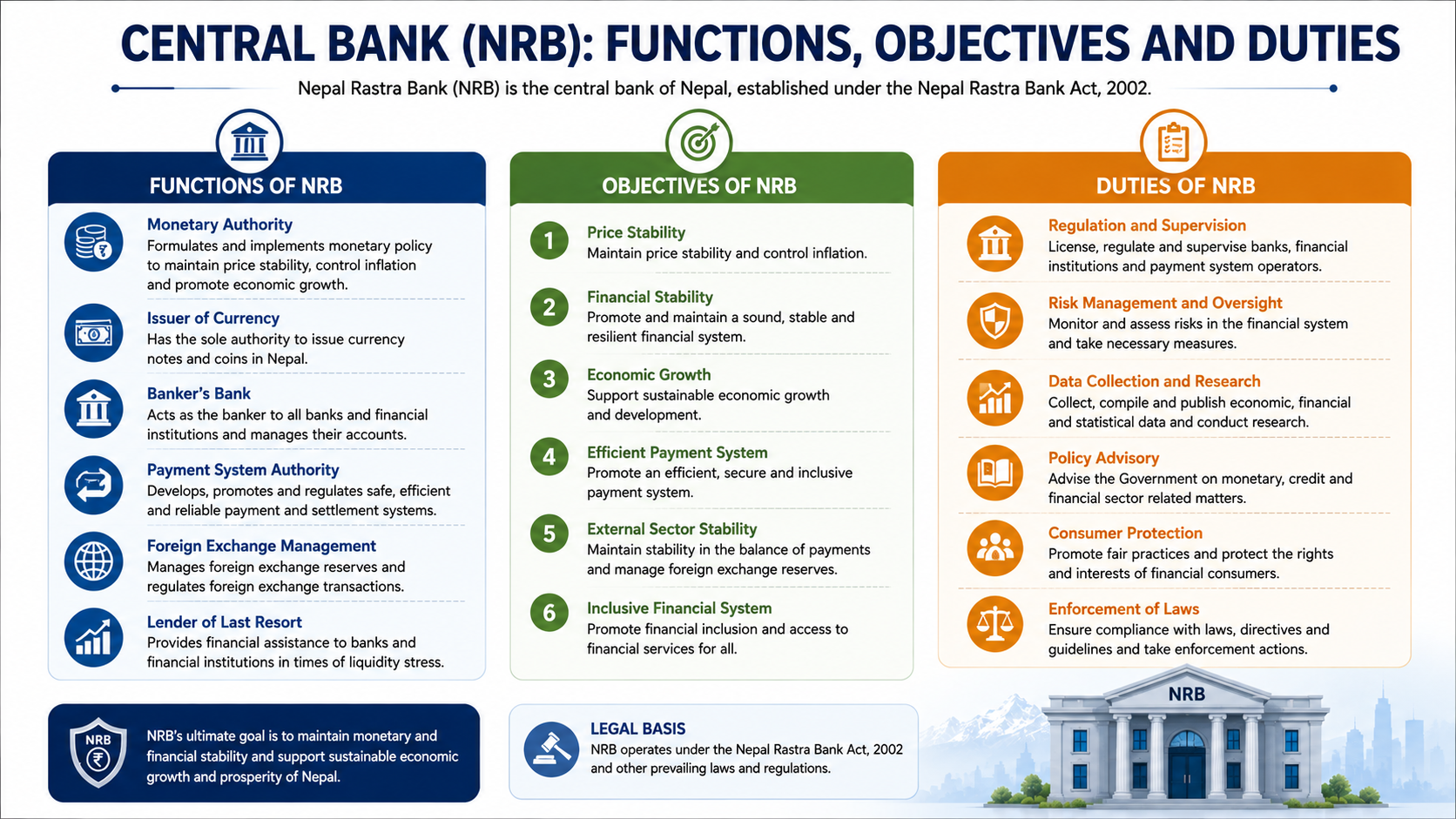








Functions, Objectives and Duties of Nepal Rastra Bank (NRB)
- Introduction
Nepal Rastra Bank (NRB) is the central bank of Nepal. It was established on April 26, 1956, under the Nepal Rastra Bank Act, 1955. The current principal legal framework is the Nepal Rastra Bank Act, 2058 (2002).
As the central bank, NRB is different from commercial banks. A commercial bank mainly accepts deposits and provides loans to customers, whereas NRB is responsible for monetary policy, foreign exchange policy, banking regulation and supervision, financial stability, currency management, payment systems and important banking services for the government and financial institutions.
The Nepal Rastra Bank Act specifically sets out the Bank’s objectives in Section 4 and its functions, duties and powers in Section 5.
- Objectives of Nepal Rastra Bank
Under Section 4 of the Nepal Rastra Bank Act, the major objectives of NRB can be grouped into three broad areas.
Objective 1: Maintain Price and External-Sector Stability
NRB formulates and manages monetary and foreign-exchange policies to maintain:
- Price stability
- Balance-of-payments stability
- Overall economic stability
- Conditions for sustainable economic development
What does price stability mean?
Price stability means avoiding excessive and persistent inflation or deflation.
For example, if prices rise very rapidly, the purchasing power of money falls. NRB can use monetary-policy measures affecting interest rates, credit and liquidity to address inflationary pressures arising from demand conditions.
What is balance-of-payments stability?
It means maintaining a sustainable external position in Nepal’s transactions with the rest of the world.
NRB therefore monitors:
- Imports
- Exports
- Remittances
- Tourism income
- Foreign investment
- External payments
- Foreign exchange reserves
- Objective 2: Maintain Banking and Financial-Sector Stability
NRB aims to maintain a stable banking and financial system and increase public confidence in that system.
It also seeks to broaden people’s access to financial services.
This objective is achieved through:
- Licensing banks and financial institutions
- Regulation
- Supervision
- Monitoring
- Prudential requirements
- Risk management requirements
- Corporate-governance standards
- Financial-consumer protection
NRB explains that its regulatory function includes issuing necessary directions to financial institutions to protect depositors and stakeholders and maintain financial-sector stability.
- Objective 3: Develop a Secure, Healthy and Efficient Payment System
Another statutory objective is to develop a secure, healthy and efficient payment system.
This is particularly important in the digital economy.
NRB therefore has an important role in:
- Payment systems
- Clearing
- Settlement
- Electronic payments
- Digital financial services
- Payment-system security
- Efficient financial transactions
- Cooperation with Government Economic Policies
The Act also provides that NRB shall, without prejudicing its statutory objectives, extend cooperation in implementing the economic policies of the Government of Nepal.
This means NRB and the government have different but interconnected responsibilities.
Government
Mainly deals with fiscal policy, including:
- Government revenue
- Government expenditure
- Taxation
- Public borrowing
- Government programs
NRB
Mainly deals with:
- Monetary policy
- Foreign-exchange policy
- Banking regulation
- Financial stability
- Payment systems
- Functions and Duties of Nepal Rastra Bank
Section 5 of the Nepal Rastra Bank Act specifically identifies the Bank’s functions, duties and powers. The statutory list includes issuing currency, monetary policy, foreign exchange, reserves, licensing and supervision of financial institutions, government banking services, lender-of-last-resort functions, and payment systems.
Let’s examine each in detail.
- Function 1: Issue Banknotes and Coins
One of NRB’s fundamental functions is to issue banknotes and coins.
NRB manages the supply and circulation of Nepalese currency.
This involves:
- Issuing currency
- Managing currency circulation
- Maintaining currency quality
- Replacing damaged notes
- Maintaining public confidence in currency
- Ensuring adequate availability of cash
The authority to issue banknotes and coins is expressly included in Section 5 of the NRB Act.
Why is this important?
If currency were issued without proper monetary management, excessive money supply could contribute to inflation and undermine confidence in the currency.
- Function 2: Formulate and Implement Monetary Policy
NRB formulates and implements monetary policy to help maintain price stability.
Monetary policy influences:
- Money supply
- Credit
- Interest rates
- Liquidity
- Inflation
- Economic activity
NRB’s statutory function is to formulate necessary monetary policies for maintaining price stability and implement them or cause them to be implemented.
Major monetary-policy tools
Depending on the monetary-policy framework and prevailing regulations, NRB uses instruments such as:
- Policy rates
- Open-market operations
- Cash Reserve Ratio (CRR)
- Liquidity facilities
- Deposit collection operations
- Refinance facilities
- Other quantitative and qualitative instruments
- Function 3: Formulate and Implement Foreign-Exchange Policy
NRB formulates and implements foreign-exchange policy.
Foreign exchange is essential for international transactions such as:
- Imports
- Exports
- Foreign education
- Foreign travel
- International payments
- Debt servicing
- Foreign investment
- Remittance transactions
The NRB Act expressly gives the Bank responsibility for formulating and implementing foreign-exchange policies.
- Function 4: Determine the Foreign-Exchange Rate System
NRB has the statutory function of determining the foreign-exchange-rate system.
Nepal’s exchange-rate arrangement has major implications for:
- Import prices
- Export competitiveness
- Inflation
- Foreign investment
- External-sector stability
- Foreign-exchange reserves
This is therefore an important component of monetary and external-sector management.
- Function 5: Manage and Operate Foreign-Exchange Reserves
NRB manages Nepal’s foreign-exchange reserves.
Foreign reserves provide Nepal with the capacity to meet international payment obligations and act as an important buffer against external shocks.
NRB’s responsibilities include managing reserve assets in accordance with applicable policies, laws and risk-management principles.
The management and operation of foreign-exchange reserves is specifically identified as an NRB function under Section 5.
- Function 6: License Banks and Financial Institutions
NRB has the authority to issue licenses to commercial banks and financial institutions to conduct banking and financial business.
It also regulates and supervises those institutions after licensing.
The NRB’s Banks and Financial Institutions Regulation Department specifically identifies licensing and regulation through directives, circulars and notices among its functions.
Why licensing is important
Licensing helps ensure that institutions entering the banking business meet minimum requirements relating to:
- Capital
- Management
- Governance
- Business plans
- Risk management
- Infrastructure
- Legal compliance
- Function 7: Regulate Banks and Financial Institutions
NRB establishes regulatory requirements for banks and financial institutions.
Regulation can cover:
- Capital adequacy
- Liquidity
- Loan classification
- Provisioning
- Credit concentration
- Risk management
- Corporate governance
- Financial reporting
- Consumer protection
- Anti-money laundering
- Other prudential requirements
NRB’s regulatory role is aimed at protecting depositors and maintaining financial-sector stability.
- Function 8: Inspect Banks and Financial Institutions
Regulation alone is not enough. NRB must also determine whether banks and financial institutions are complying with applicable requirements.
Therefore, NRB carries out inspection and supervision.
It can examine areas such as:
- Financial condition
- Loan portfolio
- Capital adequacy
- Liquidity
- Governance
- Risk management
- Compliance
- Internal controls
- Function 9: Supervise and Monitor Financial Institutions
NRB continuously monitors the financial condition and activities of regulated institutions.
Supervision helps identify problems before they become serious.
For example, NRB can monitor:
Rapid credit growth → Rising credit risk → Weak loan quality → Potential banking-sector instability
Early identification allows regulatory intervention where necessary.
- Function 10: Banker to the Government
NRB acts as the banker of the Government of Nepal.
As government banker, it performs banking-related functions for the government, including maintaining government accounts and facilitating government transactions.
This makes NRB an important part of Nepal’s public financial system.
- Function 11: Advisor to the Government
NRB also acts as an economic and financial advisor to the Government of Nepal.
It can provide analysis and advice on matters such as:
- Monetary conditions
- Banking
- Foreign exchange
- Financial stability
- Balance of payments
- Inflation
- Financial markets
- Macroeconomic developments
The role of banker, advisor and financial agent to the government is specifically provided in Section 5.
- Function 12: Financial Agent of the Government
NRB also acts as the financial agent of the Government of Nepal.
This involves functions associated with government financial operations and government securities within the applicable legal framework.
Government securities may include:
- Treasury bills
- Development bonds
- Other government debt instruments
- Function 13: Banker to Banks and Financial Institutions
NRB is known as the banker’s bank.
Commercial banks and other financial institutions maintain relationships with NRB for purposes such as:
- Reserve requirements
- Settlement
- Liquidity management
- Payment systems
- Other central-banking services
This places NRB at the center of Nepal’s banking system.
- Function 14: Lender of Last Resort
NRB also acts as the lender of last resort.
This means that under the applicable legal and regulatory framework, NRB can provide liquidity support to eligible banks and financial institutions when they face serious temporary liquidity difficulties.
Importance
This function helps:
- Prevent bank runs
- Maintain depositor confidence
- Reduce systemic risk
- Maintain financial stability
The lender-of-last-resort function is expressly included in Section 5 of the NRB Act.
- Function 15: Develop Payment, Clearing and Settlement Systems
NRB is responsible for establishing and promoting systems for:
- Payment
- Clearing
- Settlement
It also regulates these activities.
This function is increasingly important because modern financial transactions are moving from cash toward electronic and digital payments.
- Function 16: Liquidity Management
NRB manages liquidity conditions in the financial system.
Liquidity management involves influencing the amount of funds available to banks and financial institutions.
If liquidity is excessive:
It can contribute to:
- Excessive credit growth
- Inflationary pressure
- Asset-price pressures
If liquidity is too low:
It can cause:
- Higher funding costs
- Credit contraction
- Difficulty meeting obligations
- Reduced economic activity
Therefore, NRB attempts to maintain appropriate liquidity conditions.
NRB itself identifies liquidity management among its major functions.
- Function 17: Refinance Facilities
NRB can provide refinance facilities to eligible banks and financial institutions under applicable policies and procedures.
NRB’s Banks and Financial Institutions Regulation Department lists providing refinance to BFIs among its key functions.
Refinance can be used as a policy mechanism to support particular sectors or address specific economic conditions.
- Function 18: Promote Financial Inclusion
NRB seeks to broaden access to financial services.
Financial inclusion means making financial services accessible to a larger proportion of the population.
It can involve:
- Bank accounts
- Savings
- Credit
- Digital payments
- Remittance services
- Microfinance
- Financial literacy
Broadening access to financial services is expressly included among NRB’s statutory objectives.
- Function 19: Maintain Public Confidence
A banking system cannot function effectively without public confidence.
People must believe that:
- Banks are safe
- Deposits are handled responsibly
- Payments will work
- Financial institutions are supervised
- The monetary system is stable
NRB therefore works to increase public confidence through regulation, supervision, monetary management and financial stability measures.
- Function 20: Maintain Financial Stability
Financial stability is one of the most important broader responsibilities of NRB.
NRB monitors risks that could affect the financial system, including:
- Credit risk
- Liquidity risk
- Market risk
- Operational risk
- Governance weaknesses
- Systemic risk
The purpose is to prevent problems from spreading across the banking system.
- Function 21: Consumer and Depositor Protection
NRB’s regulation and supervision help protect depositors and financial consumers.
Its regulatory approach aims to ensure that financial institutions follow appropriate rules and provide financial services within the regulatory framework.
NRB’s regulatory function specifically refers to protecting depositors and related stakeholders while maintaining financial-sector stability.
NRB’s regulatory department also lists handling grievances of financial consumers among its functions.
- Function 22: Promote a Healthy Banking System
NRB works to develop a banking system that is:
- Safe
- Sound
- Efficient
- Competitive
- Transparent
- Stable
This involves continuous improvement in:
- Regulation
- Supervision
- Corporate governance
- Risk management
- Technology
- Financial infrastructure
- Function 23: Support Economic Development
NRB is not a commercial development agency, but its monetary and financial policies can support sustainable economic development.
A stable financial system helps businesses and households obtain financing and conduct transactions.
NRB’s strategic framework emphasizes monetary management, external-sector management, prudent regulation and supervision, digitalization and financial inclusion.
- Function 24: Conduct Economic and Financial Research
A central bank needs reliable economic information to formulate appropriate policy.
NRB therefore collects and analyzes information relating to:
- Inflation
- Money supply
- Credit
- Deposits
- Interest rates
- Foreign exchange
- Foreign reserves
- Balance of payments
- Banking-sector performance
- Macroeconomic developments
It also publishes statistical and financial reports.
- Function 25: Banking and Financial Statistics
NRB publishes information and statistics about banks and financial institutions.
Its Banks and Financial Institutions Regulation Department lists publication of monthly and quarterly statistics/reports among its functions.
Such statistics are useful to:
- Government
- Banks
- Businesses
- Researchers
- Investors
- Students
- General public
- Function 26: Merger and Acquisition Regulation
NRB also plays a regulatory role in mergers and acquisitions of banks and financial institutions.
Its regulatory department specifically lists regulation of mergers and acquisitions among its functions.
Mergers can help create institutions with:
- Stronger capital
- Better risk-bearing capacity
- Greater operational efficiency
- Improved governance
- Better financial stability
- Function 27: Promote Digital Financial Services
As Nepal’s financial system becomes increasingly digital, NRB’s responsibilities increasingly involve:
- Digital payments
- Electronic transactions
- Payment-system oversight
- Financial technology
- Cybersecurity-related financial risks
- Consumer protection in digital finance
The development of a secure and efficient payment system is one of NRB’s statutory objectives.
- Objectives vs Functions
Objectives answer:
‘What does NRB want to achieve?’
For example:
- Price stability
- Balance-of-payments stability
- Financial-sector stability
- Greater financial access
- Secure payment system
Functions answer:
“What does NRB do to achieve those objectives?”
For example:
- Formulates monetary policy
- Manages foreign exchange reserves
- Regulates banks
- Issues currency
- Supervises financial institutions
- Operates payment systems
- Functions of NRB — Short Summary
For easy memorization:
- Currency
Issue banknotes and coins.
- Monetary Policy
Formulate and implement monetary policy.
- Foreign Exchange
Formulate and implement foreign-exchange policy.
- Exchange Rate
Determine the foreign-exchange-rate system.
- Foreign Reserves
Manage foreign-exchange reserves.
- Licensing
License banks and financial institutions.
- Regulation
Regulate BFIs.
- Inspection
Inspect BFIs.
- Supervision
Supervise and monitor BFIs.
- Government Banker
Act as banker to the government.
- Government Advisor
Provide financial and economic advice.
- Financial Agent
Act as financial agent of the government.
- Banker’s Bank
Act as banker to BFIs.
- Lender of Last Resort
Provide last-resort liquidity support where appropriate.
- Payment System
Develop and regulate payment, clearing and settlement systems.
- Liquidity Management
Manage liquidity in the financial system.
- Financial Inclusion
Increase access to financial services.
- Financial Stability
Maintain a safe and stable banking system.
These core functions are based on Section 5 of the Nepal Rastra Bank Act and NRB’s own description of its responsibilities.
- Objectives of NRB — Easy-to-Remember Version
Remember the 3 major statutory objectives:
- Price & External Stability
Maintain price and balance-of-payments stability through monetary and foreign-exchange policies.
- Financial Stability & Access
Maintain banking and financial-sector stability, increase public confidence and broaden access to financial services.
- Payment System
Develop a secure, healthy and efficient payment system.
These are the core objectives stated by NRB and under Section 4 of the NRB Act.
- How NRB’s Functions Affect the Economy
The relationship can be illustrated as:
NRB
↓
Monetary + Foreign Exchange Policy
↓
Money Supply + Credit + Interest Rates + Liquidity
↓
Consumption + Investment + Production
↓
Employment + Income + Economic Activity
↓
Economic Stability + Sustainable Development
At the same time:
NRB Regulation & Supervision
↓
Safer Banks
↓
Depositor Confidence
↓
Financial Stability
And:
NRB Payment-System Development
↓
Efficient Digital & Electronic Payments
↓
Lower Transaction Friction
↓
More Efficient Economy
- Importance of NRB’s Functions
The functions of NRB are important because the central bank provides the institutional foundation for Nepal’s monetary and financial system.
Without effective central-bank functions, there could be risks of:
- Excessive inflation
- Banking instability
- Poor-quality lending
- Bank runs
- Liquidity crises
- Foreign-exchange problems
- Payment-system failures
- Loss of public confidence
- Financial-sector instability
Therefore, NRB serves as an important guardian of monetary and financial stability.
- Exam-Oriented Answer
If this question comes in a BBA, BBS, MBA, banking, finance or competitive examination, you can structure your answer as follows:
Introduction
Nepal Rastra Bank is the central bank of Nepal, established in 1956. Under the Nepal Rastra Bank Act, 2058 (2002), it is responsible for monetary and foreign-exchange policy, banking and financial-sector stability, and development of a secure, healthy and efficient payment system.
Objectives
- Maintain price stability.
- Maintain balance-of-payments/external-sector stability.
- Support overall economic stability and sustainable economic development.
- Maintain banking and financial-sector stability.
- Increase public confidence in the banking and financial system.
- Increase access to financial services.
- Develop a secure, healthy and efficient payment system.
- Cooperate with government economic policies without compromising its statutory objectives.
Major Functions and Duties
- Issue banknotes and coins.
- Formulate and implement monetary policy.
- Formulate and implement foreign-exchange policy.
- Determine the foreign-exchange-rate system.
- Manage foreign-exchange reserves.
- License banks and financial institutions.
- Regulate banks and financial institutions.
- Inspect, supervise and monitor BFIs.
- Act as banker to the Government of Nepal.
- Act as advisor to the government.
- Act as financial agent of the government.
- Act as banker to banks and financial institutions.
- Act as lender of last resort.
- Develop and regulate payment, clearing and settlement systems.
- Manage liquidity.
- Provide refinance facilities according to applicable policies.
- Promote financial inclusion.
- Protect depositors and financial consumers through regulation and supervision.
- Promote financial stability.
- Collect, analyze and publish financial and economic information.
- Regulate mergers and acquisitions of BFIs.
- Support development of secure and efficient digital financial systems.
- Conclusion
Nepal Rastra Bank is the apex monetary and financial authority of Nepal. Its objectives are centered on price and external-sector stability, banking and financial-sector stability, broader access to financial services, and a secure and efficient payment system. Its functions include currency issuance, monetary-policy implementation, foreign-exchange management, reserve management, licensing and supervision of banks and financial institutions, government banking services, lender-of-last-resort facilities, liquidity management and payment-system development.