






Definition of a Bank
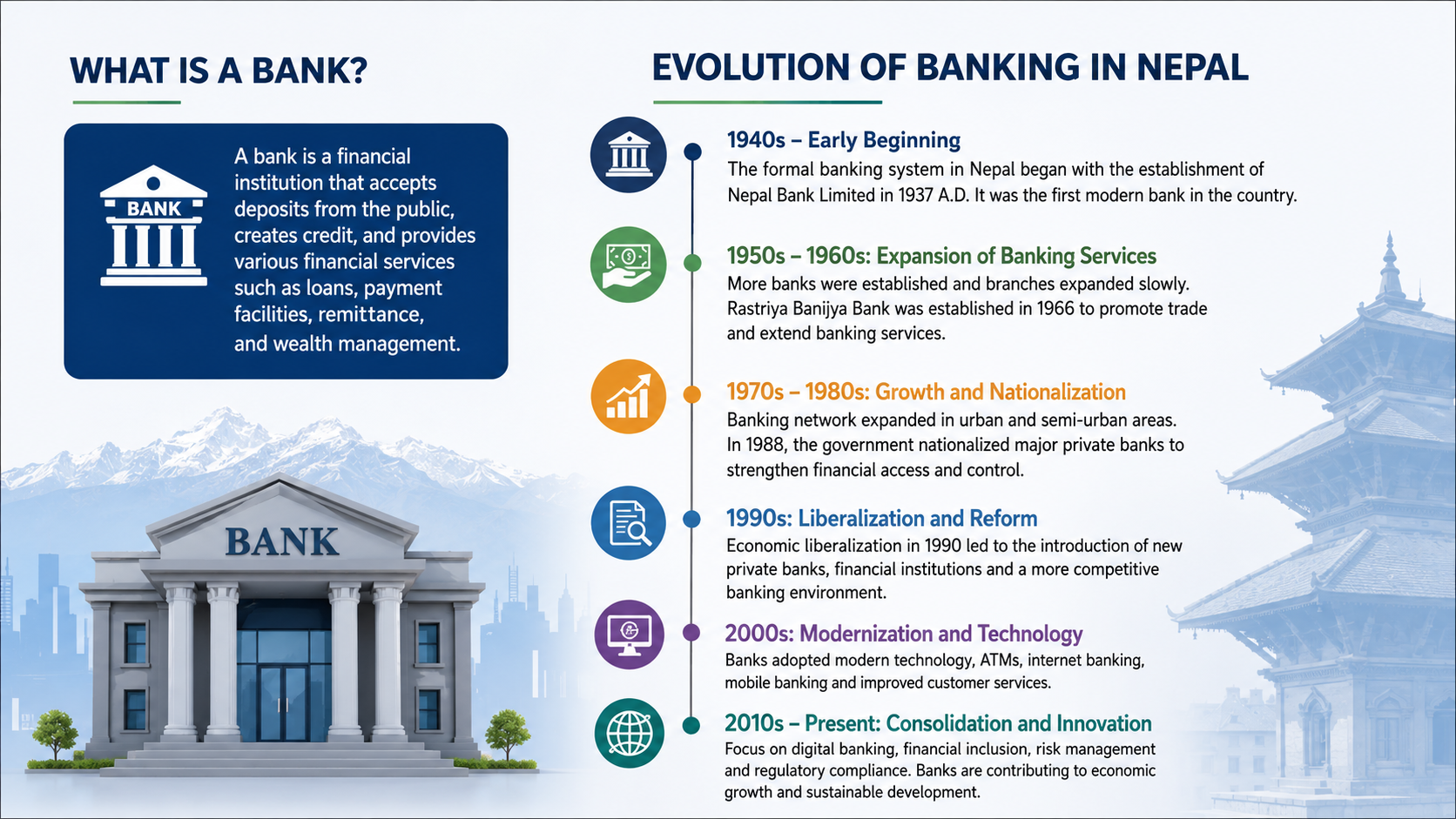
A bank is a financial institution that accepts deposits from individuals, businesses, and other organizations and uses those funds to provide loans and other financial services. In simple terms, a bank acts as a financial intermediary between savers and borrowers.
Banks collect money from people who have surplus funds and make it available to people, businesses, and governments that need funds for consumption, investment, trade, or other purposes.
Main functions of a bank
- Accepting deposits – Banks accept savings, current, fixed, and other types of deposits.
- Providing loans and advances – Banks lend money for agriculture, business, housing, education, industry, consumption, etc.
- Credit creation – Commercial banks create credit through their lending activities.
- Payment and settlement services – Banks facilitate cheques, cards, mobile banking, internet banking, electronic transfers, and other payments.
- Remittance services – Banks facilitate domestic and international money transfers.
- Foreign exchange services – Banks buy and sell foreign currencies and facilitate international transactions.
- Agency services – Banks may collect bills, dividends, and other payments on behalf of customers.
- Investment and financial services – Banks provide services related to government securities, investment, guarantees, letters of credit, and other financial instruments.
- Economic development – Banks mobilize savings and channel them into productive sectors, contributing to economic growth.
Evolution of Banking in Nepal
The development of banking in Nepal can be divided into several major stages. Nepal’s banking system evolved from a relatively simple system of money lending and traditional financial practices into a modern banking and digital financial system.
- Traditional Financial System
Before the establishment of modern banks, Nepal did not have a formal institutional banking system.
People relied mainly on:
- Dukuti
- Dhikuti
- Guthi
- Money lenders (Sahu/Mahajan)
- Merchants and traders
- Informal borrowing and lending among family and community members
Money lenders provided loans, often at relatively high interest rates. Gold, silver, land, agricultural products, and other assets could be used in financial transactions.
Traditional institutions such as Dhikuti also helped communities mobilize money collectively. However, these arrangements lacked the standardized regulation, deposit protection, monetary management, and formal credit mechanisms associated with modern banking.
- Establishment of Nepal Bank Limited – 1937
The most important milestone in Nepal’s modern banking history was the establishment of Nepal Bank Limited (NBL) in 1937 AD (1994 BS).
It was the first modern commercial bank in Nepal.
Before Nepal Bank was established, Nepal’s financial system was largely informal. The establishment of Nepal Bank introduced institutional banking practices such as:
- Deposit collection
- Formal lending
- Banking accounts
- Cheque facilities
- Organized credit
- Banking records and procedures
The establishment of Nepal Bank marked the beginning of modern banking in Nepal.
- Establishment of Nepal Rastra Bank – 1956
A major turning point occurred with the establishment of Nepal Rastra Bank (NRB) in 1956 AD (2013 BS).
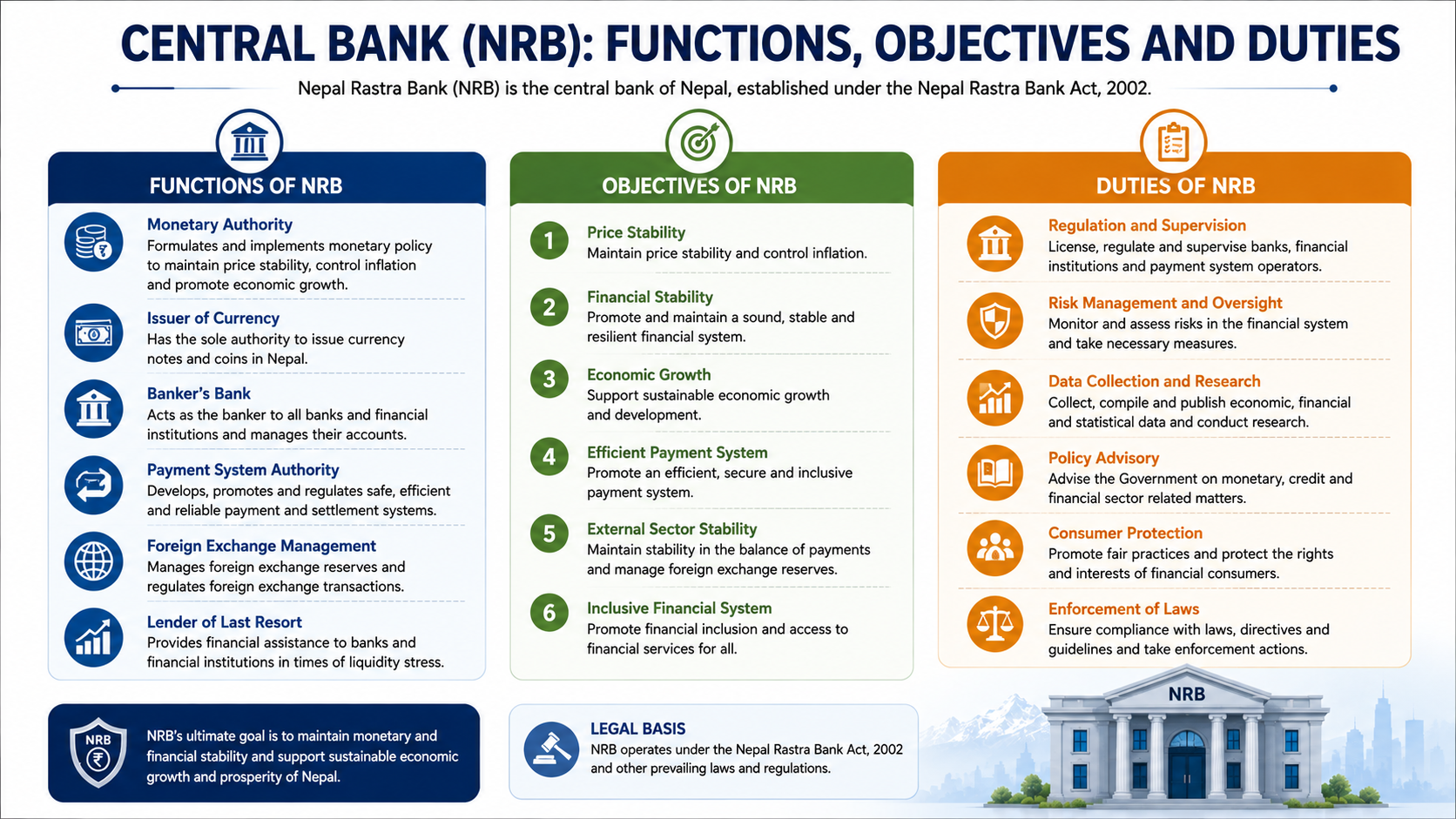
Nepal Rastra Bank is the central bank of Nepal.
Its establishment created an institution responsible for managing and regulating the country’s monetary and financial system.
Major responsibilities of Nepal Rastra Bank
- Formulating and implementing monetary policy
- Regulating banks and financial institutions
- Managing foreign exchange reserves
- Issuing currency
- Acting as banker to the government
- Acting as banker to banks
- Maintaining financial stability
- Supervising banks and financial institutions
- Developing payment and settlement systems
The establishment of NRB provided a formal regulatory framework for Nepal’s banking sector.
- Establishment of Rastriya Banijya Bank – 1966
The next major development was the establishment of Rastriya Banijya Bank (RBB) in 1966 AD (2022 BS).
It was established as a government-owned commercial bank.
RBB played a significant role in expanding banking services outside major urban centers and supporting government economic policies.
Its activities included:
- Deposit mobilization
- Agricultural lending
- Industrial lending
- Business financing
- Government-related banking services
- Expansion of banking branches
The establishment of RBB significantly increased the reach of formal banking in Nepal.
- Agricultural Development Bank of Nepal – 1968
The Agricultural Development Bank of Nepal (ADBL) was established in 1968 AD (2024 BS).
Its principal objective was to provide financial resources to the agricultural sector and rural population.
The bank played an important role in:
- Agricultural loans
- Rural credit
- Financing farmers
- Cooperatives
- Small businesses
- Rural development
This was particularly important because Nepal’s economy was heavily dependent on agriculture.
The establishment of ADBL represented a shift toward sector-specific and rural-oriented banking.
- Expansion of Specialized Financial Institutions
During the following decades, Nepal gradually developed specialized financial institutions to meet the financing needs of different sectors.
These institutions focused on areas such as:
- Industrial development
- Agricultural development
- Housing
- Rural credit
- Export and import financing
- Small and medium enterprises
The government increasingly recognized that banking was not only about deposits and loans but also about supporting economic development and financial inclusion.
- Liberalization of the Banking Sector
A major transformation occurred after Nepal adopted economic liberalization policies, particularly from the 1980s and 1990s.
The government began encouraging greater private-sector participation in banking and finance.
As a result, the number of private banks and financial institutions increased.
One of the most important developments was the establishment of Nabil Bank in 1984, initially known as Nepal Arab Bank Limited.
It became the first joint-venture commercial bank in Nepal.
The entry of joint-venture and private banks increased:
- Competition
- Banking innovation
- Customer service
- Technology adoption
- New financial products
- Private-sector credit
- International banking practices
- Development of Financial Institutions
During the 1990s and 2000s, Nepal experienced rapid growth in banks and financial institutions.
The financial system came to include several categories of institutions.
Under Nepal Rastra Bank’s regulatory framework, banks and financial institutions were historically categorized into:
Class A -Commercial Banks
Commercial banks provide a broad range of banking services, including:
- Deposits
- Loans
- Corporate banking
- Trade finance
- Remittance
- Foreign exchange
- Digital banking
Class B -Development Banks
Development banks generally focus on development-oriented lending and financial services.
Class C -Finance Companies
Finance companies provide financial services such as deposits and credit, subject to their regulatory framework.
Class D – Microfinance Financial Institutions
Microfinance institutions primarily serve low-income customers, micro-enterprises, and financially underserved communities.
This classification helped organize Nepal’s rapidly expanding financial sector.
- Growth of Microfinance
Another important stage in Nepal’s banking evolution was the development of microfinance.
Microfinance institutions were established to provide financial services to people who had limited access to traditional banks.
They focused particularly on:
- Low-income households
- Small farmers
- Micro-enterprises
- Rural communities
- Women entrepreneurs
- Small-scale businesses
Microfinance helped expand financial inclusion and brought formal financial services to previously underserved sections of society.
- Financial Sector Reform and Consolidation
The rapid growth in the number of banks and financial institutions also created challenges.
Some of the major concerns included:
- Excessive competition
- Duplicate branches
- Corporate governance problems
- Weak risk management
- Non-performing loans
- Capital adequacy concerns
- Institutional instability
To strengthen the financial system, Nepal Rastra Bank introduced various regulatory reforms.
One important approach was merger and acquisition (M&A).
Banks and financial institutions began merging to create stronger institutions with:
- Larger capital bases
- Better risk management
- Improved operational efficiency
- Stronger governance
- Greater capacity to finance large projects
As a result, Nepal’s financial sector has undergone substantial consolidation.
- Introduction of Modern Banking Technology
The next major stage was the transformation from traditional branch-based banking to technology-driven banking.
Banks increasingly introduced:
- Automated Teller Machines (ATMs)
- Debit cards
- Credit cards
- Point-of-Sale (POS) systems
- Internet banking
- Mobile banking
- SMS banking
- Electronic fund transfers
- QR payments
Technology dramatically changed how customers interact with banks.
Customers no longer need to visit a branch for many routine transactions.
- Development of Digital Banking
Digital banking has become one of the most important developments in Nepal’s banking history.
Banks now offer services through:
Mobile Banking
Customers can:
- Check balances
- Transfer money
- Pay bills
- Recharge mobile phones
- Pay merchants
- Manage accounts
Internet Banking
Customers can perform many banking transactions through online platforms.
QR Payments
QR-based payments have expanded rapidly among:
- Retailers
- Restaurants
- Small businesses
- Service providers
- Individual customers
Digital Wallets and Payment Platforms
The broader financial ecosystem also includes digital wallets and electronic payment systems.
This has moved Nepal’s financial system increasingly toward a cashless and digital economy.
- Development of Payment and Settlement Systems
Nepal’s banking evolution has also involved significant development of payment infrastructure.
Electronic payment systems allow customers and institutions to transfer funds quickly without relying entirely on physical cash.
The development of systems and institutions associated with electronic payments has supported:
- Interbank transfers
- Retail payments
- Digital transactions
- Government payments
- Business payments
- Remittances
The modernization of payment infrastructure has become an important part of Nepal’s financial-sector development.
- Banking and Financial Inclusion
Another important objective of Nepal’s banking development has been financial inclusion.
Financial inclusion means ensuring that people have access to useful and affordable financial products and services.
Banks and financial institutions have expanded services through:
- Branch expansion
- Branchless banking
- Mobile banking
- Microfinance
- Digital wallets
- Agent banking
- QR payments
- Financial literacy programs
These developments have helped bring formal financial services to rural and previously underserved populations.
- Banking and Remittance
Remittance has become an important component of Nepal’s economy.
Nepali migrant workers send money home through formal financial channels, including banks and licensed remittance companies.
Banks play an important role in:
- Receiving remittances
- Depositing remittance income
- Transferring money domestically
- Providing accounts to remittance recipients
- Connecting customers with international payment networks
The growth of remittance has also encouraged greater participation in the formal financial system.
- Current Structure of Nepal’s Banking Sector
Today, Nepal has a diversified banking and financial system regulated principally by Nepal Rastra Bank.
The system includes:
- Commercial banks
- Development banks
- Finance companies
- Microfinance institutions
- Infrastructure/development-oriented financial institutions
- Payment service providers and related financial institutions
The banking sector now operates across both traditional and digital channels.
Modern banks provide services to:
- Individuals
- Farmers
- Micro and small businesses
- SMEs
- Large corporations
- Government institutions
- Importers and exporters
- Remittance recipients
Conclusion
The evolution of banking in Nepal has been a transition from informal money-lending and community-based financial practices to a regulated, diversified and technology-driven financial system.
The establishment of Nepal Bank Limited in 1937 marked the beginning of modern banking. The establishment of Nepal Rastra Bank in 1956 created the foundation for central banking and financial regulation. The subsequent establishment and expansion of Rastriya Banijya Bank, Agricultural Development Bank, private banks, development banks, finance companies and microfinance institutions expanded access to financial services.
In recent years, the banking sector has moved rapidly toward digital banking, electronic payments, mobile banking, QR payments, financial inclusion, consolidation and technology-based financial services.
Thus, the history of banking in Nepal can broadly be understood as:
Traditional finance → Nepal Bank → Central banking → Government banking → Agricultural/development banking → Private and joint-venture banking → Financial liberalization → Consolidation → Digital banking and financial inclusion.
The evolution of banking has therefore played a crucial role in mobilizing savings, providing credit, supporting trade and investment, facilitating remittances, promoting financial inclusion, and contributing to Nepal’s overall economic development.